There are many ways to meditate. Vipassana is different.
It isn't about clearing your mind, repeating a mantra or simply finding a moment of calm. At its core, Vipassana is a practice of observing the mind and body as they are — learning to notice sensations, thoughts and emotions without immediately reacting to them.
The word Vipassana is commonly translated as “seeing things as they really are”. In the tradition taught by S.N. Goenka, the practice is learned through a structured residential course, traditionally lasting ten days. Courses are offered around the world and follow a remarkably simple principle: the teaching is given freely, with courses supported entirely by donations.
For anyone curious about meditation, self-observation or going deeper into their inner world, Vipassana offers something quite different from the usual wellness experience.
What is Vipassana meditation?
Vipassana is an ancient meditation technique rooted in the Buddhist tradition of India. In the tradition taught by S.N. Goenka, it is presented as a practical method of self-observation rather than a religious ritual.
The practice begins with Anapana meditation, where attention is placed on the natural breath to develop concentration and awareness. Once the mind has become more focused, students are introduced to Vipassana itself: systematically observing sensations throughout the body while maintaining a balanced, non-reactive mind.
The principle sounds simple.
The practice is not.
Rather than trying to make pleasant sensations last or push unpleasant ones away, you learn to observe both with equanimity — recognising that everything is continually changing. Over time, the practice becomes an exercise in seeing your habitual reactions more clearly.
How does the Vipassana meditation technique work?
This is what makes Vipassana different from many forms of meditation. You are not being asked to stop thinking. You are not trying to visualise something, repeat a phrase or create a particular emotional state. Instead, you observe.
You begin by becoming aware of the natural breath. From there, attention is gradually developed so that you can observe sensations throughout the body. These sensations may be subtle or intense, pleasant or uncomfortable, and constantly changing. The important part is how you respond.
The practice asks you to notice what is happening without immediately grasping at what feels good or resisting what feels unpleasant. This cultivation of awareness and equanimity is central to the technique.
In the Goenka tradition, Vipassana is therefore understood as something to be experienced directly rather than simply understood intellectually. You learn by sitting, observing and repeatedly coming back to what is happening in the present moment.
Vipassana is not simply “sitting quietly”
One of the easiest misconceptions about Vipassana is that a ten-day course is essentially an extended meditation retreat. It is much more structured than that. A traditional 10-day course involves a strict daily timetable, many hours of meditation, silence and a set of guidelines designed to create the conditions for sustained practice.
You eat simply. You sleep simply. You spend most of your time practising. There are no excursions, entertainment or wellness treatments to distract you from the process. And that is very much the point. The environment removes many of the things we normally use to distract ourselves from what is happening internally.
What happens during a 10-day Vipassana course?
The standard introductory Vipassana course lasts ten full days of meditation. Students arrive for registration and orientation before beginning the course, and leave on the morning of the eleventh day. The technique is introduced progressively, with each day building on the previous one.
Days 1–3: Developing concentration
The first three days focus on Anapana, observing the natural breath. The aim is to develop concentration and awareness. Rather than following every thought that appears, you repeatedly bring your attention back to the breath. It can sound deceptively simple. For many people, this is when they first discover just how active the mind really is.
Day 4: Vipassana begins
On the fourth day, the Vipassana technique is introduced. Attention moves from the breath towards sensations throughout the body. Students learn to observe these sensations without reacting to them, developing awareness alongside equanimity.
From this point onwards, the practice becomes increasingly focused on direct observation of bodily sensations and the mind's tendency to react to them.
Days 5–9: Going deeper into the practice
The remaining days are dedicated to continuing the Vipassana practice. There is no need to search for a particular experience. Pleasant sensations are observed. Unpleasant sensations are observed. Restlessness is observed. Stillness is observed. The practice is to remain aware and balanced through all of it.
The repetition is intentional. Rather than learning Vipassana as an idea, you spend day after day actually practising it.
Day 10: Returning to the world
On the tenth day, Noble Silence comes to an end and students gradually begin communicating with one another again. The final day also introduces Metta, a practice of goodwill and compassion, before students prepare to leave. The following morning marks the end of the course.
What is the daily schedule like?
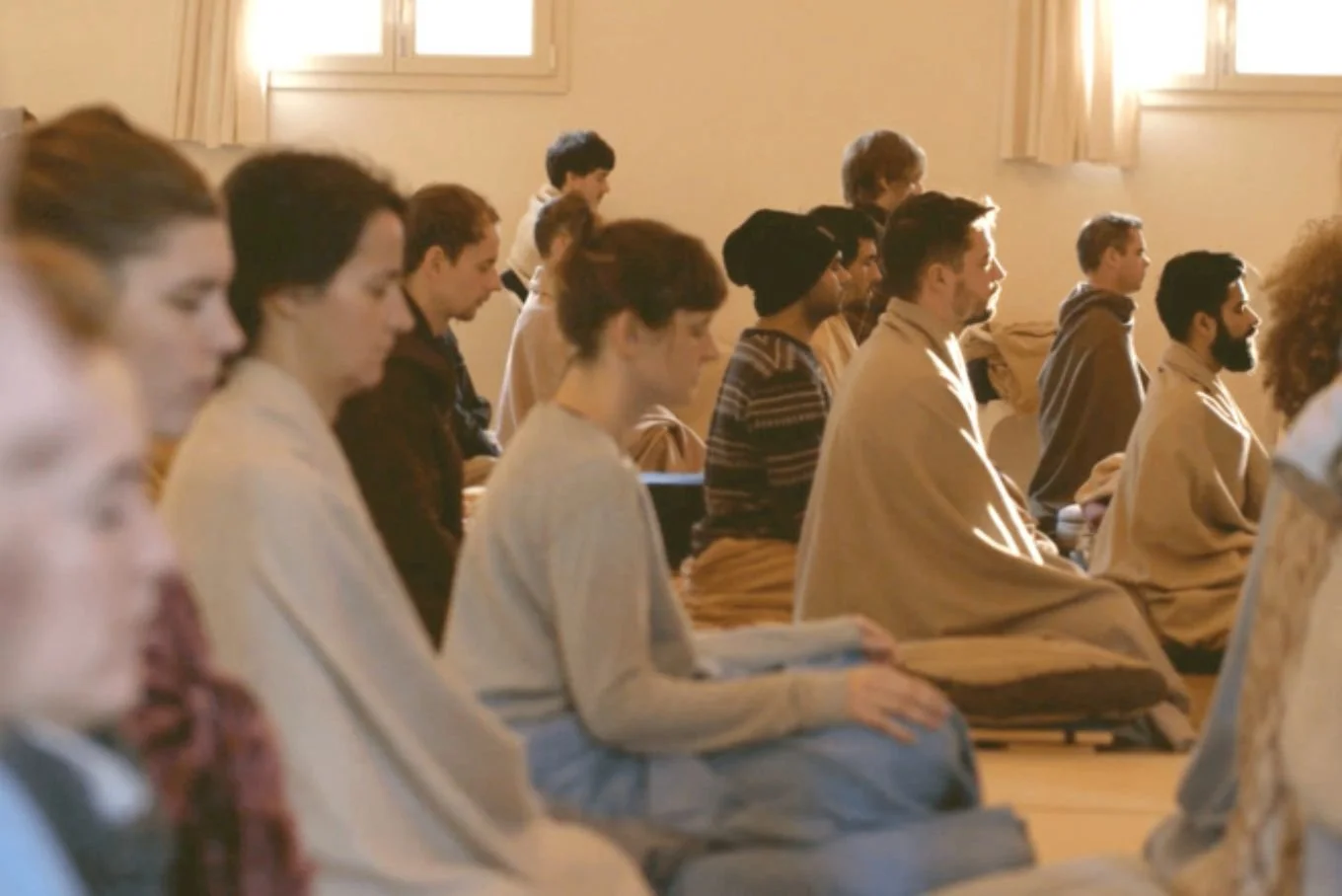
One of the first things to understand about a Vipassana course is just how structured the days are. There is very little to organise or decide for yourself. The timetable is designed to keep the practice continuous from early morning until evening.
A typical day in a 10-day course looks like this:
4:00 am — Wake-up bell
The day begins early.
4:30–6:30 am — Meditation
Students meditate in the meditation hall or in their own room.
6:30–8:00 am — Breakfast and break
Time to eat and rest.
8:00–9:00 am — Group meditation
One hour of meditation together in the meditation hall.
9:00–11:00 am — Meditation
Individual practice in the hall or in your room, according to the teacher's instructions.
11:00 am–12:00 pm — Lunch
The main meal of the day.
12:00–1:00 pm — Rest and teacher interviews
Time to rest, with an opportunity to speak privately with the teacher when needed.
1:00–2:30 pm — Meditation
Continued individual practice.
2:30–3:30 pm — Group meditation
Another hour of meditation together.
3:30–5:00 pm — Meditation
Individual practice.
5:00–6:00 pm — Tea break
A short break before the evening sessions.
6:00–7:00 pm — Group meditation
One hour of meditation together.
7:00–8:15 pm — Evening discourse
A recorded evening discourse by S.N. Goenka, explaining the practice, its principles and the experiences students may be having.
8:15–9:00 pm — Meditation
The final meditation session of the day.
9:00–9:30 pm — Question time
An opportunity to ask questions about the technique or the course.
9:30 pm — Lights out
The timetable contains around ten hours of meditation throughout the day, alongside meals, rest and teaching. The exact schedule can vary slightly between centres, but the overall structure remains highly consistent. It is intense, but the structure is intentional.
There is no need to think about where to go, what to do or how to fill the day. For ten days, almost everything unnecessary is stripped away, leaving you with one thing to practise: observing.
Why is Vipassana a 10-day retreat?
Ten days can sound like an extraordinarily long time to meditate. According to the Vipassana tradition taught by S.N. Goenka, however, the ten-day course is the standard introductory format in which the technique is taught step by step.
The idea is that the mind needs time to settle before deeper observation can take place. The first days therefore aren't simply about “meditating for ten days”; they progressively build towards learning and practising Vipassana itself. It is an immersion rather than a workshop. And that is one of the reasons the experience can feel so different from attending a one-hour meditation class.
Why is there silence during Vipassana?
Silence is an essential part of the traditional course structure.
Students observe what is known as Noble Silence, which means refraining from communication with fellow students. There are also restrictions around reading, writing, phones, music and other forms of entertainment. This isn't intended as punishment or isolation for its own sake. The idea is to remove as many external distractions as possible so that attention can turn inward. Without conversations to maintain, messages to answer or books to disappear into, there is considerably less to do except observe what is happening in the mind and body.
For some people, that is one of the most challenging parts of the experience. It can also be one of the most revealing.
What should you expect from your first Vipassana course?
It is worth going in with realistic expectations. A Vipassana course is not designed to be relaxing in the conventional sense. You may experience boredom, restlessness, discomfort, resistance or a very busy mind. You may also experience moments of extraordinary stillness. But the point isn't to chase a particular experience.
Pleasant or unpleasant, the practice is to observe what arises and learn not to react automatically. You will sit for long periods. You will have very little external stimulation. You will eat simply, follow a schedule and spend a lot of time alone with your thoughts. For some, that sounds intimidating. For others, it is exactly what they have been looking for.
Is Vipassana a religious practice?
No, Vipassana in the Goenka tradition is presented as a universal practice rather than requiring students to adopt a particular religion or belief system. The technique has its roots in the teachings of the Buddha, but the courses emphasise practical experience and direct observation. Students are not asked to convert or adopt a new religion. Instead, they are asked to practise the technique and observe what happens for themselves. This emphasis on direct experience is fundamental to the way Vipassana is taught.
Is Vipassana free?
Yes — in the Goenka tradition, Vipassana courses are offered entirely on a donation basis. There is no fixed charge for the teaching, accommodation or food. Courses are funded by donations from students who have completed a course and want to make the same opportunity available to others.
Teachers and assistant teachers do not receive remuneration for teaching, and those who serve the courses volunteer their time. The organisation describes this as keeping Vipassana free from commercialisation. This is a deliberate part of the tradition. The idea is to keep the practice accessible regardless of someone's financial circumstances.
You don't pay for a luxury retreat experience. You come to learn the technique, and if you feel that you have benefited, you can choose to donate according to your means. That model is one of the things we find most beautiful about Vipassana.
How do you apply for a Vipassana course?
If you are interested in attending a course, the first step is to find a suitable centre and read the course information and Code of Discipline carefully. The application process is handled through the individual Vipassana centres and course schedules. Ten-day courses can fill up, so it is worth checking the schedule and applying in advance.
It is also important to understand the commitment before applying. Vipassana is accessible, but it is not casual. The structure and discipline are an important part of the experience.
A book to read before or after Vipassana
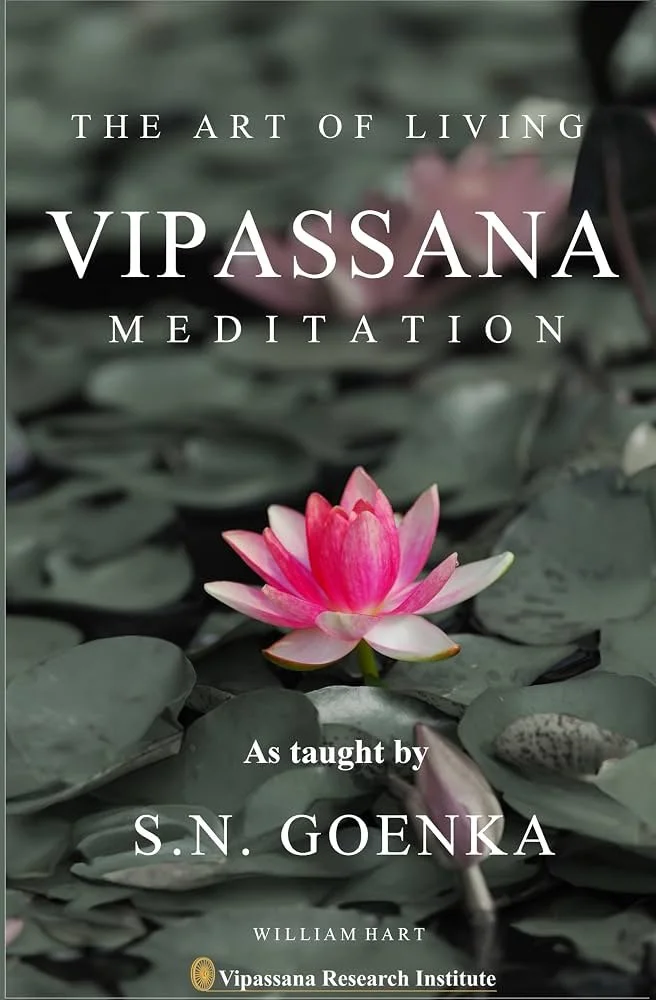
If you want to understand the practice before committing to ten days of silence, The Art of Living: Vipassana Meditation as Taught by S. N. Goenka by William Hart is a wonderful place to start.
Written under Goenka's guidance, the book offers an accessible introduction to Vipassana, its technique and the principles behind the practice. It is especially useful if you are curious about what actually happens during a course and why the practice is structured in this particular way.
But perhaps the best thing about the book is that it doesn't ask you to simply believe in Vipassana. It encourages you to understand the principles — and ultimately to experience the practice for yourself.
Read The Art of Living →
Why we think Vipassana is worth knowing about
There is something deeply beautiful about a practice that has resisted becoming a product. In a world where meditation can come with memberships, apps, retreats, treatments and increasingly elaborate wellness experiences, Vipassana remains remarkably simple.
You sit.
You observe.
You learn to notice what happens inside you without immediately reacting.
And the course itself is offered through a system of generosity: one student benefits from the donations of those who came before, and can later choose to make the same opportunity available to someone else. That simplicity is part of what drew us to it.
Whether you ultimately sit a ten-day course or simply become curious about the technique, Vipassana offers an invitation that feels increasingly rare: to step away from noise, consumption and distraction, and spend some uninterrupted time simply observing what is already there.
Sometimes, that can change the way you see everything else.
Ready to explore Vipassana?
You don't need to know whether ten days of silence are for you before becoming curious.
Start by learning about the technique. Read The Art of Living. Explore the course schedule. And if, somewhere along the way, you feel drawn to experience it for yourself, there are Vipassana centres around the world waiting to welcome you.
Explore Vipassana courses →
Frequently asked questions about Vipassana
What does Vipassana mean?
Vipassana is commonly translated as “seeing things as they really are”. In the Goenka tradition, it refers to a meditation technique based on self-observation and awareness of changing bodily sensations and mental processes.
How long is a Vipassana course?
The standard introductory course consists of ten full days of meditation, with students leaving on the morning of the eleventh day.
Is Vipassana really free?
Courses in the Goenka tradition are run entirely on donations. There is no fixed charge for teaching, accommodation or food. Students who have completed a course can choose to donate according to their means.
Can beginners do Vipassana?
Yes. The ten-day course is the standard introductory course and teaches the technique step by step.
Can you talk during Vipassana?
Students observe Noble Silence during most of the course, meaning they do not communicate with fellow students. There are specific opportunities to speak with the course management or teacher when necessary.
Is Vipassana a religion?
The Goenka tradition presents Vipassana as a universal meditation technique rather than requiring students to adopt a particular religion or belief system. The practice has roots in the teachings of the Buddha and is taught through direct experience.
What does a day during Vipassa look like?
A typical 10-day course includes around ten hours of meditation spread throughout the day, alongside meals, rest and evening teaching.
What time do you wake up during Vipassana?
The typical timetable begins with a wake-up bell at 4:00 am, with the first meditation session beginning at 4:30 am.
What time do you go to bed during Vipassana?
The typical schedule ends at 9:30 pm, when lights are turned out.
What is the hardest part of Vipassana?
That depends entirely on the person. The long hours of meditation, early mornings, silence, lack of external stimulation and confronting a busy or restless mind can all be challenging.
What is the point of Vipassana?
The practice is centred on developing awareness and equanimity through direct observation of bodily sensations and mental processes. Rather than trying to control every thought or feeling, you learn to observe what arises without automatically reacting to it.